


© 2004-2024 Sustainable Tompkins | 309 N. Aurora St., Ithaca, NY 14850 | 607-272-1720 | info@sustainabletompkins.org | Login


“Sustainable Tompkins” is now “Sustainable Finger Lakes.” As our programs evolve and expand beyond Tompkins County we have rebranded. The content on this site is currently being migrated to our Sustainable Finger Lakes website and we will soon retire this site. Go to our Sustainable Finger Lakes website to get all of our latest updates!
News & Events
Neighborhood Mini-Grant Program Featured in Ithaca Week


Photo by Caroline Grass
Ithaca College publication Ithaca Week showcased the Sustainable Finger Lakes Neighborhood Mini-Grant Program in an article by Caroline Grass, featuring interviews with Neighborhood Mini-Grant Coordinator Sasha Paris and the recipients of two April 2023 grants supporting native botany education at the Marshy Garden Project and the Lansing Center Trail. This program has benefited people throughout Tompkins County to an incalculable degree since it began in 2008, and is in dire need of new supporters.
For the full article, visit https://www.ithacaweek-ic.com/mini-grant-program-helps-grassro
Neighborhood Mini-Grant Applications Due October 1
 Do you have an idea for a project to make our community more sustainable, resilient, or inclusive? Need a little help in covering the costs? Sustainable Finger Lakes is accepting applications for our fall 2023/winter 2024 round of Neighborhood Mini-Grants.
The Sustainable Finger Lakes Neighborhood Mini-Grant program supports initiatives improving environmental sustainability, equity, and environmental, economic, and social justice in Tompkins County. Since it began in 2008, it has awarded more than $85,000 in 221 grants to innovative grassroots projects throughout the county.
Grants range from $150 to $750 and support initiatives promoting sustainable food systems, alternative transportation, waste reduction/reuse, energy conservation/fossil fuel use reduction, and environmental education, and addressing social and economic inequality.
Proposals are reviewed biannually by a team of community members. The program is sponsored by NYSEG, Craig Riecke, and local donors.
Individuals, organizations, and neighborhood groups are welcome to apply, as are local microbusinesses seeking to green their operations or extend their products or services to low-income clientele. Priority is given to new and/or small entities with relatively few sources of support.
Successful initiatives
Applications must be received on or before October 1, 2023. To request an application form, or if you have questions, please call (607) 272-1720 or email sasha@sustainablefingerlakes.org.
Neighborhood Mini-Grants Support Rural Initiatives
From staple foods to bicycling infrastructure to botany education, small locally-based initiatives can help to meet the needs and improve the lives of people in rural areas. In April 2023, Sustainable Finger Lakes awarded a total of $2,500 in four Neighborhood Mini-Grants supporting such projects across Tompkins County.
Artist/ecologist Ash Ferlito and ecological landscape designer Brandon Hoak have created and maintained the Marshy Garden, a habitat restoration project and educational venue at The Soil Factory south of Ithaca. This year, they seek to increase the garden’s biodiversity and habitat value, along with expanding the on-site array of educational programming for college students and the public. A Neighborhood Mini-Grant will support their purchase of native plants for this purpose from Grow Wild Nursery in Brooktondale.
The organization Friends of the Lansing Center Trail will install informational plant identification signs in the native plant garden near the entrance to the popular Lansing Center Trail in the Town of Lansing, aiming to educate trail visitors and encourage gardening with native plants. A Neighborhood Mini-Grant will contribute to the purchase of these signs.
The organization Groton Community Cupboard, formerly Groton Food Providers, runs a food pantry serving a large and growing need for food assistance in an area without a full grocery store. They are moving the food pantry to a new location, which will need renovation, and striving to maintain operation during the transition. A Neighborhood Mini-Grant will help to pay the expenses of this endeavor.
Dryden resident Kate McKee will install bike racks at four small businesses throughout the Village of Dryden to facilitate local bicycle travel. A Neighborhood Mini-Grant will pay for the racks, along with chains and locks.
The Neighborhood Mini-Grant Program provides seed money to diverse initiatives to build environmental, economic, and social resilience and well-being in Tompkins County. The program is sponsored by NYSEG, Craig Riecke, and local donors. The next deadline for the Mini-Grant program will be October 1, 2023. To request an application or learn more, email sasha@sustainablefingerlakes.org.
Signs of Sustainability
Justice As a Verb – Putting the Love and Belonging into Creating Sustainable Communities
Tompkins Weekly 5-8-24
By Gail Patrice Lockert Anthony
Most of us living in the United States have similar dreams, ambitions, cares, and concerns. We weep, laugh, and have pride in many of the same things. For some, though, (those who’ve been historically and systemically marginalized, brutalized, oppressed); we live in two separate nations. The first is where we are beautifully human and full of potential and possibilities. The second is about sustaining life itself in a country built for protecting and prospering whiteness and putting systems into place that serve as gatekeepers against “other” being protected or prospering.
If we are choosing to do the work of putting justice in food systems…and operating for long term well-being; we must reassess our what, why, and how in the current food system. What makes a healthy food system accessible? Why don’t we already have healthy food systems accessible to all? What are the causal symptoms of the system’s inequities? And in the face of all of that, how do we create one which does serve us all? We should begin by asking ourselves what is the current social infrastructure that frames access to healthy food today? What kind of social infrastructure is needed to assure all ease of access to fresh nourishing food all the time?
The Greenest Home in Ithaca
Tompkins Weekly 4-24-24
By Eric Banford
I recently received an invitation to a party at “The Greenest Home in Ithaca” celebrating some friends disconnecting their NYSEG gas line from their home. This self-proclaimed title of “greenest home” intrigued me, so I checked in with co-owner Todd Saddler about this bold statement.
“Back when we built the house, some friends of ours wrote an article about our home in Fresh Dirt Ithaca Magazine titled ‘The Greenest House in Ithaca.’ Instead of asking analytically if it was true, we just embraced it,” he shared with a laugh. “If it caught your attention then it’s serving its function, which is to get people to think about what we can do.”
Over the past few years, as climate change has become more problematic, Saddler and his partner Laurie Konwinski came up with a five year plan to “get off gas,” which was still being used for backup heat, water and cooking. Last September they were able to achieve “net zero,” which is when a home makes all of its own energy. “We installed a 400 amp electric panel, a demand electric water heater (for backup), heat pumps, a charger for our electric car, and an induction range,” said Saddler. “As of September we haven’t used any natural gas, and this week NYSEG disconnected our hookup.”
Earth Day is Only a Place to Start
Tompkins Weekly 4-10-24
By Aaron Fernando
While traveling years ago, I made friends with perhaps the only person I know who has a negative carbon footprint.
He plants trees for a small stipend. He doesn’t own a vehicle, and when he needs to get around, he borrows a small motorcycle. Mostly, he walks. He has never taken a flight. His family lives in a dwelling made of cloth, scrap metal, and plastic. His home has no electricity, and when he charges his phone, he uses solar power from nearby buildings because the electrical grid has been non-functional for years. He has little education and no meaningful economic opportunities. His name is Krichna, and he is a 26 year-old Haitian.
If we focus on a simple, individualistic metric—the carbon footprint—Krichna is doing amazing. But if we understand the world in all its fullness and empathize with real people, we know that all is not right with this oversimplified understanding of sustainability. If you feel Krichna is not thrilled with his life, you would be correct. He wants to move to the United States, where our carbon footprints are massive. He wants this because the quality of life he experiences with a negative carbon footprint—in the inequitable and unjust world we have arrived at today—is completely untenable.
ST Blog
Older Posts
SAVE THE DATE for our first Finger Lakes Forecast webinar: April 27 at 12pm ESTEnergy and Equity Go Hand in Hand
Home Rule and the Greater Good
“Getting Climate Action Right”
by Osamu Tsuda, member of Sustainable Tompkins Board of Directors
Climate Change – we hear about it a lot these days. Whether it is your neighbor talking about how the weather has become more extreme over the past decade or news reports about how we need to pass climate policy to avoid catastrophic disasters, the information and chatter on the topic can be overwhelming. From violent storms in the south, extensive wildfires in the west, severe flooding in the east, to melting ice caps in the north, as individuals we can feel quite helpless at times and resort to blocking it all out. Maybe if we wait long enough the problems will resolve themselves. After all, what kind of impact could we really have as individuals?
As it turns out, there is a lot we can do! It is often easy to see all the destruction happening around us and forget or ignore the amazing resilient nature of human beings. Despite the delays and controversy, there have been many efforts to address the major threat of Climate Change, and now New York State is in the process of developing a climate action plan that will shape the fate of our state and the nation as a whole. Read more…
Register today for “Finger Lakes Forecast: Climate Disruption & Food Security” (April 27)
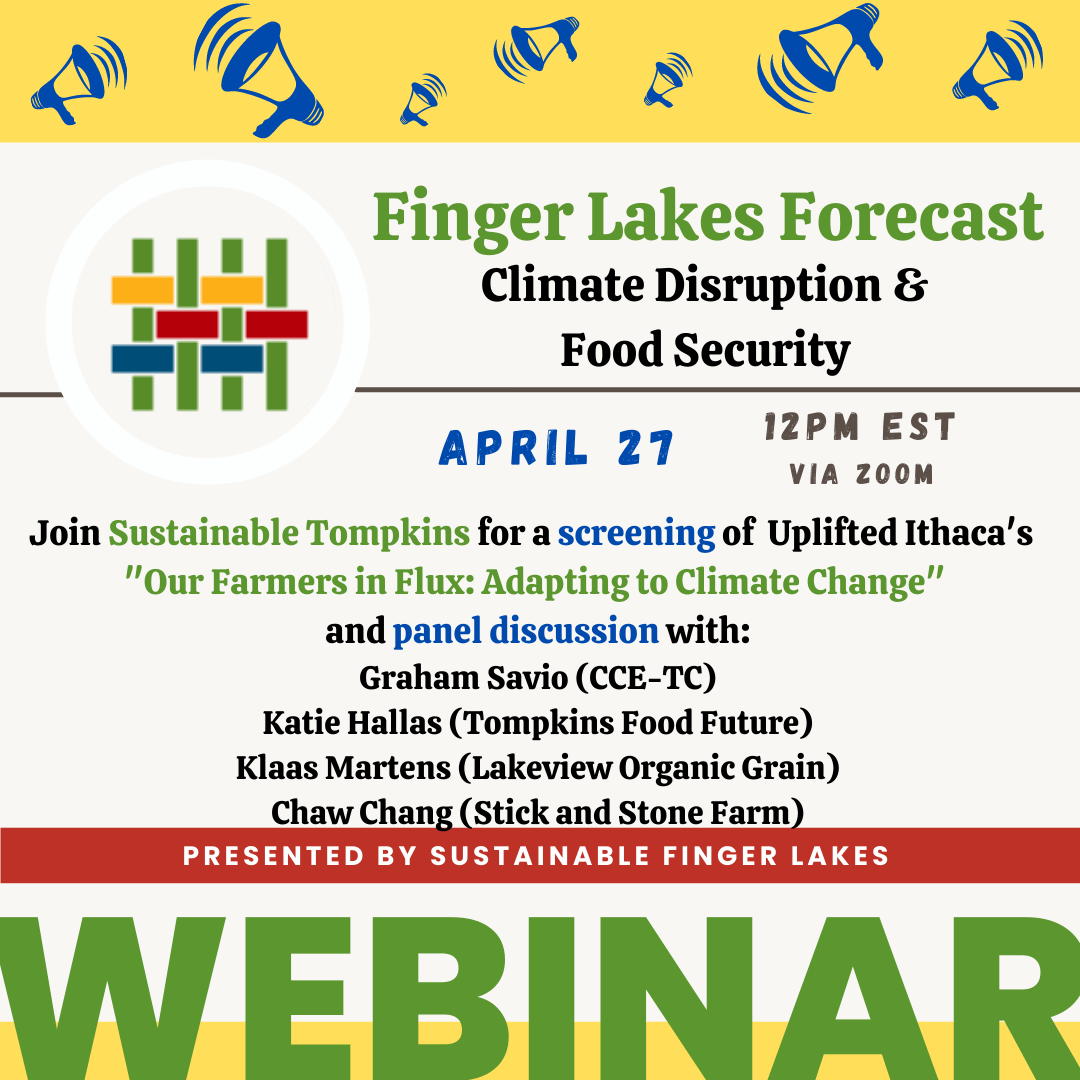 Our new webinar series, Finger Lakes Forecast, focuses on how climate change will impact life in the Finger Lakes Region and what people can do for themselves and their communities to prepare. This webinar series is free and open to the public. The first of these webinars, Climate Disruption and Food Security, will take place at 12pm EST on April 27 and include a screening of Uplifted Ithaca’s short documentary, Our Farmers in Flux: Adapting to Climate Change, followed by a panel discussion with Graham Savio, Cornell Cooperative Extension Tompkins County; Katie Hallas, Tompkins Food Future; Klaas Martens, Lakeview Organic Grain; and Chaw Chang, Stick and Stone Farm. Register online. https://bit.ly/Apr27forecast
On May 25th, we will host our second Finger Lakes Forecast webinar which will explore ways residents of the Finger Lakes can reduce flood risk for their homes. Additional topics to be covered in the webinar series include Policies to Reduce Harmful Algae Blooms in the Finger Lakes, Land Use and Renewable Energy, Public Health in a Hotter Finger Lakes, and FLX Demographic and Economic Trends.
Sustainable Tompkins is a citizen-based coalition working towards a more sustainable regional community. We advocate a systems approach to build the infrastructure and social capacity for more sustainable ways of living and working. Our projects and programs have focused on energy efficiency, climate protection, green purchasing, sustainable community development, green collar jobs, sustainable enterprise, and economic/ecological justice. Our office is open by appointment at 309 N. Aurora Street in Ithaca.
To learn more, email our Outreach Coordinator at sarah@sustainabletompkins.org.
Sustainable Tompkins Puts Sustainability on the Map
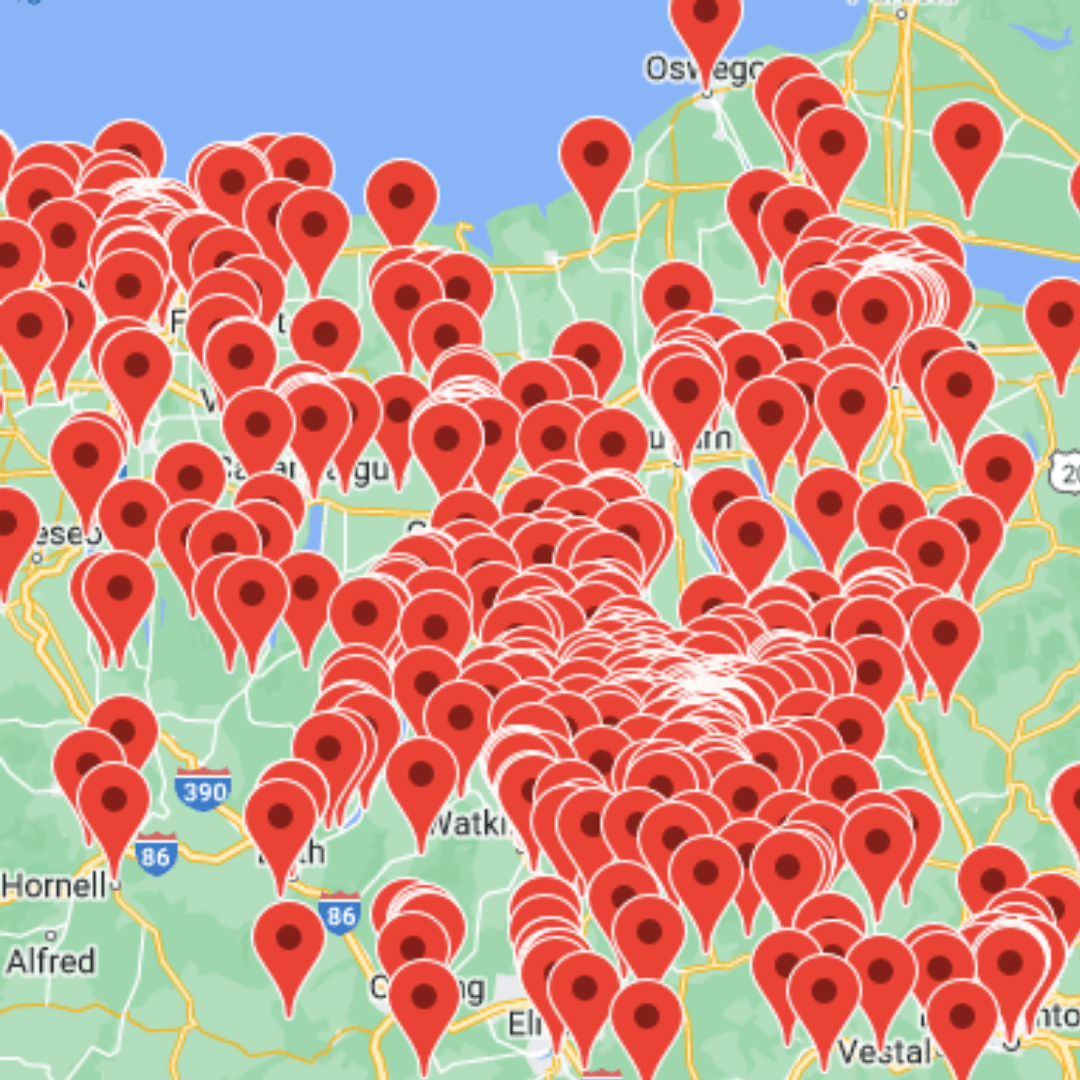 The Sustainable Finger Lakes Map created by Sustainable Tompkins provides a visual interface for people interested in learning more about the regional sustainability movement. People are coming together across our region to relocalize the economy, make our systems of local governance more just and democratic, and protect our land, air, and water for future generations. The Map currently has over 800 entries and allows visitors to quickly search 8 main categories of sustainable living for local programs, businesses, and activities. Regional businesses or groups are invited to put themselves on the Map! If they are working on some aspect of a more sustainable system, they can register online and submit a short description of their sustainability efforts, and contact information. Submissions are reviewed on a weekly basis.
With a shared goal to assure a future landscape in which all of us can thrive despite the many changes underway, community members are invited to help build this map of the sustainability and democracy movement in the Finger Lakes Region. Residents can add what they are working on, plug in where they can make a difference, and spread the word to share with others. Visit the Map to discover the creative and the compassionate, the solidarity builders and the self-reliant, the pioneers and the protectors of a sustainable future.
Recent additions to the Map include Lev Kitchen, Central New York Labor Federation, Food Policy Council of Tompkins County, and Oxbow Farm. Located downtown on the Ithaca Commons, Lev Kitchen is one of Ithaca’s newest restaurants and features Yemeni flatbread called Malawach and the amalgamation of distinctive cuisines and cultures from countries such as Israel, Lebanon and Syria. Opened in March 2022, they aim to embrace business transparency, explore what it means to be a “sustainable” food service operator, and support food security by donating 1% of all revenues to the World Food Program and their relief efforts around the world. Read more…